

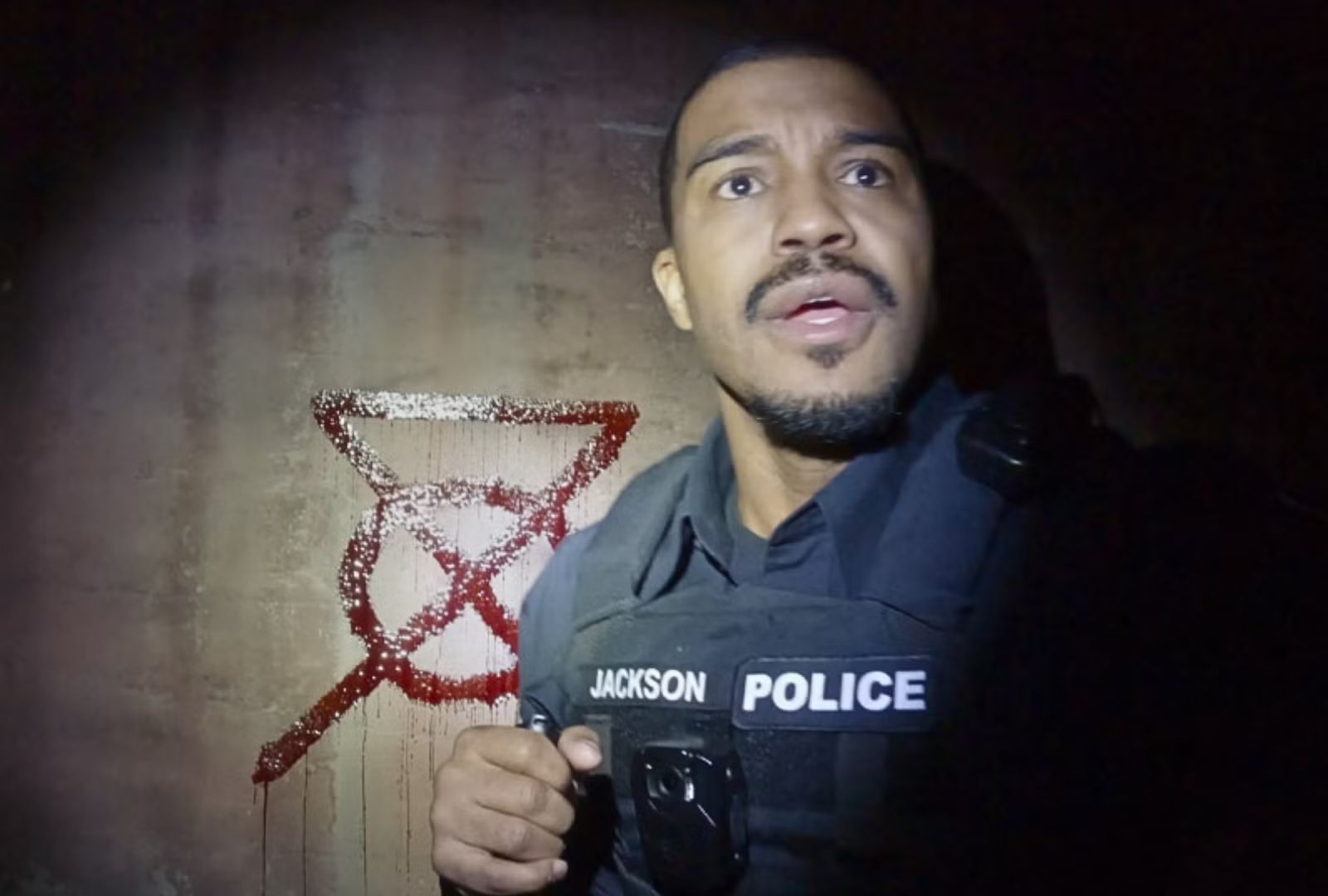
A deep pallor of cynicism runs by Bodycam, the Canadian found-footage horror from Brandon Christensen. Shot fully by cameras mounted on two cops’ chests (Jaime M. Callica and Sean Rogerson), the movie is based on the notion that its viewers may have the ability to empathize with the area of interest stress of police work. It is not the supernatural creepypasta that fuels the movie’s spooks that’ll get you. It is the notion that what these officers face each day is extra horrifying than the satan: the uncertainty of what lurks behind a decrepit house, the erratic conduct of individuals experiencing homelessness and drug dependancy, or the hanging query if what a civilian holds behind their again is a weapon.
Christensen successfully places his viewers within the our bodies of those policemen, who’re clearly working from a spot of concern and inexperience. Like many different discovered footage movies earlier than it, the formal success comes from the restricted scope of the body. In Bodycam that’s very true; going down fully at evening, the movie’s body is decreased to the odd angle of the bodycam’s fish-eye lens, crookedly positioned, and solely lit by the flashlight being held beneath a gun.
However, placing us within the emotional state of a police officer is one other query fully, and the notion here’s a bit naive. It feels a bit merciless that, so as to engender us on their characters’ frantic states of thoughts, Christensen and brother Ryan (who co-wrote the script) make the most of drained horror tropes of satanic possession to castigate essentially the most weak communities. In some methods, the movie makes a strong argument that police violence might be the results of poor preparedness and paranoia.
But overwhelmingly, the movie says one thing else: that the police are essentially overmatched by a society that has totally collapsed. It is not the system that is incorrect, it is that there are people who aren’t doing it “proper.” Certainly, the very notion of proper and incorrect policing pervades the movie as a relentless theme, as in a single scene specifically the place Jackson (Callica) is lectured by Ally (Catherine Lough Haggquist) that he hasn’t linked sufficient together with his group.
Whichever method the filmmakers specific sympathies lie appears unclear from the movie, which needs to have its cake and eat it too. Viewers capability to take pleasure in it might hinge on that uneven steadiness. At its heart is Bryce, a self-serving White cop (Rogerson), and Jackson, a kind-hearted Black cop, which is already a didactically simplistic strategy that strains credulity.
The 2 reply to a misery name in a neighborhood that appears to be barely functioning above the extent of a dystopian tent metropolis, As soon as on the home, the cops instantly discover a veritable bevy of unnerving paraphernalia. Rats crawl in all places, the wallpaper is peeling, nothing is illuminated. They cut up up — Jackson takes the upstairs and Bryce the down — and each instantly discover satanic imagery and bloodied folks in static positions. In a panicked taking pictures, Bryce kills a person and a child, and simply as rapidly suggests to his companion that it’s in each their pursuits to do what they’ll to cowl up their tracks.
In one other horror movie, the scares may emanate from Bryce’s mounting guilt, however Christensen goes the route of the supernatural. Issues get stranger and stranger for the 2 officers as they attempt to tamper with their bodycam footage, solely to find that they kind of cannot. Issues are taken to one more degree of despair when it appears that evidently Bryce’s pregnant spouse (Elizabeth Longshaw) could also be threatened as a consequence of his actions.
Bodycam is not the primary discovered footage movie to go supernatural, however it’s to its detriment that it pronounces it so rapidly. There’s no room to take a position as to what could be taking place, and as soon as it is revealed, the rising quantity of unnerving imagery loses its edge. Essentially the most horrifying factor of the movie is not the doable presence of the satan, however that neither Jackson nor Bryce identifies their mistake as killing a toddler, however slightly the tampering of the proof of stated deed. Bodycam is the indie horror equal of the “unhealthy apple” argument.
Stylistically, Bodycam has rather a lot to admire. Shot clandestinely on a shoestring finances, it provides a variety of spectacular sequences of real stress. However politically and narratively, it is fairly strained. Its runtime is just 75 minutes, however it feels for much longer, and by no means actually justifies itself as greater than a V/H/S-style quick. Besides it is not one. Given the film’s doubtful concepts about public security, that is a very long time to attempt to care about two clearly corrupted souls. And you do not want discovered bodycam footage to get to that conclusion.