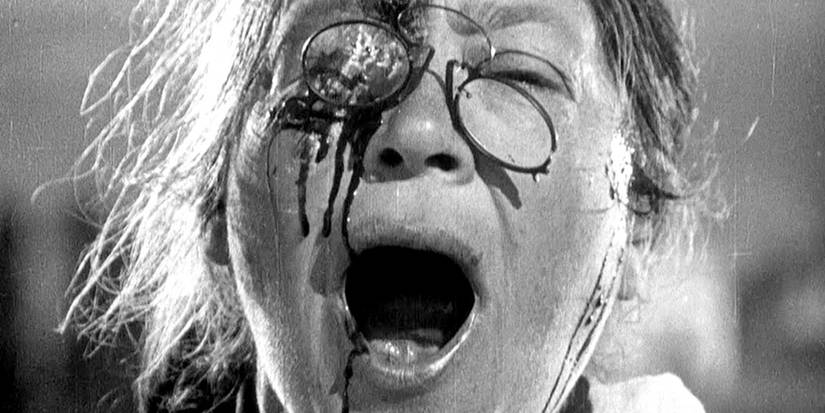
Relying on who you ask, Battleship Potemkin is both among the many best movies ever made or an unseen cinematic relic. One century later, the language of silent, black-and-white cinema utilized in Battleship Potemkin can really feel virtually as archaic because the political ideologies that outlined the period. However to dismiss the movie on these grounds is to misconceive the truism that artwork displays its period. By that measure, Battleship Potemkin rises from vital to foundational.
A movie celebrating a 20-year-old Russian revolution that was revolutionary in its personal proper, Eisenstein’s 1925 magnum opus reshaped filmmaking by way of experimental montage modifying that conveys that means and evokes emotion relatively than merely suggesting. Equally important was its unapologetic political intent, so potent that governments banned or censored the movie for worry it would incite unrest.
100 years is a very long time; know-how has since cloaked the ingenuity of filmmaking’s infancy. A watch or re-watch (regardless of the case) of Battleship Potemkin reminds viewers of how daring cinema as soon as was and the way hardly ever it has been this confrontational about oppression and collective resistance.
Battleship Potemkin Tells A Singular Occasion In One of many Darkest Moments of Russian Historical past
A proto–historic epic by fashionable requirements, Battleship Potemkin recounts the 1905 mutiny aboard the battleship Potemkin Tavrichesky of the Imperial Russian Navy’s Black Sea Fleet, unfolding throughout a 75-minute, five-act construction. Whereas the drama unfolds off the coast of Odessa, its roots lie in St. Petersburg, the place revolutionary sentiment was already fermenting in opposition to the Tsardom of Nicholas II. The common-or-garden rank and file of the roughly 12,900-ton battleship refuse to be mere bystanders within the unfolding unrest. Audiences accustomed to historical past instantly perceive why; for individuals who don’t, the movie makes it clear inside minutes.
Handled like cannon fodder by their superiors, the crew is one serving of maggot-infested meat and one outspoken sailor away from overturning the command hierarchy, which they ultimately do, fairly actually. A “Russian prisoners in Japan are higher fed than we’re” declaration from a close-by disgruntled sailor means that the injuries from Russia’s humiliating defeat within the Russo-Japanese Battle are nonetheless contemporary.
Certainly, it is a mutiny that wins unprecedented help as soon as information of it reaches Odessa’s shores, however which unsurprisingly angers the higher-ups. In what would come to be appreciated as one of many best scenes on a flight of stairs, a Cossack host brutally stamps out rioters within the streets as a squadron units underway to place the Potemkin to order.
Sergey Eisenstein’s Montage Enhancing in Battleship Potemkin Provokes Propaganda

Whereas watching Battleship Potemkin, it’s practically not possible to disregard the Soviet-era aesthetics embedded all through, most conspicuously Eisenstein’s landmark montage modifying approach. Speedy cuts between contrasting feelings, settings, and occasions clearly information the viewers to favor one facet emotionally over the opposite. Shut-ups of maggot-ridden meat are shortly juxtaposed with the disgusted faces of its would-be eaters; pictures of sailors arming themselves are intercut with senior officers working helter-skelter because the mutiny crescendos; and serene photographs of calm seas after which tough seas alternate with sleeping sailors and the stressed wandering of the crew, constructing pressure as they await visible information of the Tsar’s approaching fleet.
Eisenstein’s brilliance on this approach shines not on however off the Potemkin, particularly within the now-famous Odessa Steps. On this pièce de résistance sequence (which, as many may not know, by no means truly occurred in actual life), the collision of broad pictures of fleeing civilians with close-ups of terrified faces, falling our bodies, and the cruel troopers’ boots — a pair of which crushes a useless baby’s hand — creates a rhythm of terror and urgency.
That is no accident; it exemplifies the Soviet ideological strategy to filmmaking, which handled juxtaposition and contrasting imagery because the engine of storytelling. Each minimize is rigorously designed to impress a response. It’s straightforward to think about a 1925 home viewers watching this movie, coming off a profitable Bolshevik revolution, with patriotic hearts and much more revulsion in direction of oppression. Little surprise the Soviet authorities itself commissioned the movie, and governments overseas banned or restricted it.
Battleship Potemkin Deliberately Forgoes Individualism But Unintentionally Favors It

Staying true to the collectivism of Soviet ideology, Battleship Potemkin is, on the floor, virtually solely devoid of individualism. In different phrases, the characters behave, transfer, and are shot like items in a grand mechanism, marching towards or fleeing a shared purpose. It’s not coincidental that there’s no central character on this movie; Grigory Vakulinchuk (Aleksander Antonov), the one determine that comes near being one, doesn’t survive the second act. Males transfer en masse, in unison, with no individualism. Thus, strains like “Oh, my child” hardly make it into the title card dialogues, even when everybody expects them to.
That was Eisenstein’s and the commissioners’ intention, and it achieves the specified outcome. Nevertheless, there’s an irony — deliberate or not — that belies that function. In trying to depict the group as an indivisible unit, Eisenstein paradoxically depends on intimate close-ups that momentarily pull particular person personalities into focus, conjuring a sudden, virtually magical sense of private identification amid the mass.
From the grieving mom whose baby is gunned down, to the frantic grandmother watching her toddler’s carriage dangerously hurtle down the Odessa Steps, and the terror-stricken face of a person witnessing the carnage, Battleship Potemkin makes use of exemplary poignant moments to attract and unnerve viewers into the chaotic mess of violence wielded upon the citizenry.
Pacing Hurts Battleship Potemkin Worse Than Expertise Does

It goes with out saying that, not like within the Twenties, when black-and-white, silent movies have been the order of the day, immediately’s cinema would balk at a film the place the one shade comes from a pink flag on the ship’s mast (initially white however edited to pink). That, nevertheless, is the least side of Battleship Potemkin that might fear moviegoers.
Nothing assessments an viewers’s persistence greater than pacing, and Battleship Potemkin sometimes slows to a crawl, notably in its lingering pictures of ship mechanics. Regardless, making an excuse or two for Eisenstein on this regard is viable. These pictures in query communicate to the age of business and labor, values that the Soviet state stored near coronary heart, and might also serve to flaunt the prowess of the state’s marine engineering on the face of all who dare look. Sonically, the movie stands its floor. Eisenstein famously favored rhythm-based scores, which couldn’t be extra good when this one ship enters the lion’s den. And each model has largely stored to that imaginative and prescient.
Anybody trying to have Battleship Potemkin on their menu ought to remember to enlighten themselves in regards to the period’s socio-political consciousness. Stripped of this, it nonetheless packs sufficient punch to be an excellent watch, however it dangers being dismissed as an vintage movie relatively than the ideology-shaping machine it was designed to be.

- Launch Date
-
December 24, 1925
- Runtime
-
66 Minutes
- Director
-
Sergei Eisenstein
- Writers
-
Nina Agadzhanova, Sergei Eisenstein, Grigoriy Aleksandrov