

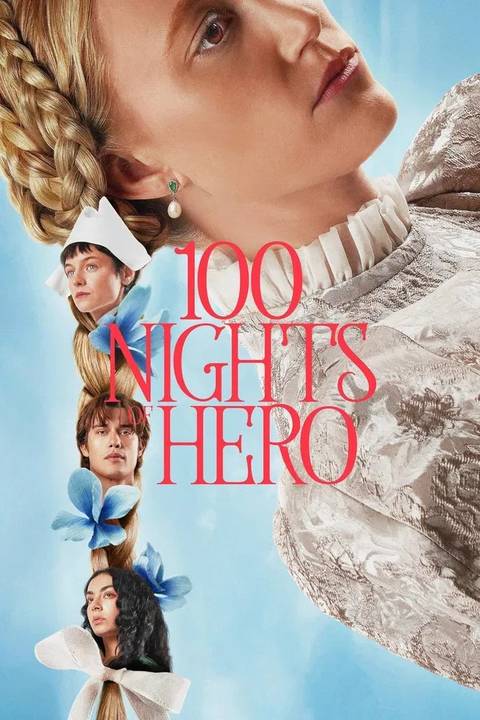
In Julia Jackman’s 100 Nights of Hero, storytelling is a revolutionary, feminist act. Based mostly on Isabel Greenberg’s graphic novel (in flip based mostly on the Center Japanese fable One Hundred and One Nights), it’s a queer fairy story with a frustratingly easy allegory. With assistance from manufacturing design by Sofia Sacomani, Jackman relies upon completely an excessive amount of on the candied aesthetic of this (barely) fictionalized, medieval world. Emma Corrin’s efficiency as Hero is managed, stunning and robust, however their admirable effort however, the movie is sunk by its incapacity to dive deeper than the floor.
Regrettably, there is not a ton right here that hasn’t been completed in stronger phrases by earlier movies with comparable palettes. In these photos, one can clearly see the affect of Wes Anderson, Sofia Coppola’s Marie Antoinette or Emerald Fennell’s Saltburn; it depends on quirk and anachronistic styling to promote its grander concepts to no nice avail. Oliver Coates’ digital rating is very irritating in its overwhelming discordance.
100 Nights of Hero Fails to Distinguish Itself From Different Anachronistic, Queer Tales
A part of the issue right here is that, regardless of its comparatively slender focus, it can not totally determine whose story that is (ironic since that is, finally, a movie about how the flexibility to inform one’s personal story will be trigger sufficient for liberation). The title means that Corrin’s character will likely be taking part in an anthology-like retelling of tales, however contained right here is actually only one: how three sisters, anchored by Rosa (Charli xcx), run into hassle by way of the easy advantage of understanding the best way to learn and write.
In the meantime, the majority of the narrative is actually targeted round Cherry (Maika Monroe), a meek housewife whose husband, Jerome (Amir El-Masry), clearly prefers the corporate of males. On this universe, the world was created by a precocious little one named Kiddo (Safia Oakley-Inexperienced) earlier than being co-opted by Birdman (Richard E. Grant), who subsequently can not stand the liberty exhibited by Kiddo’s creations and so imposes intense patriarchal legislation. The wanting it: everybody worships Birdman, wears bird-like stuff, and girls are subjected to subservience above all. Additionally: if Cherry does not get pregnant inside 100 days, she will likely be executed.
Provided that the movie is centered on a stream of White individuals whereas all actors of coloration are both pushed to the facet or solid as background filler, it turns into arduous to stroll away from the movie feeling like it’s saying something new, uncommon, nor, certainly, revolutionary, in regards to the risks of the patriarchy.
Jackman’s ire is evident, directed as it’s in the direction of a world by which males are free to roam as they’ll whereas girls are confined, but additionally blamed for the actions of males who stray too far. And, in these circumstances, Jackman introduces Manfred (Nicholas Galitzine), Jerome’s previous buddy, who rapidly makes a guess that he can seduce Cherry whereas his buddy is away. The prize if he wins: management of Jerome’s property. The latter secretly sees a chance to kill two birds with one stone. If he will get Manfred to impregnate his spouse, he can silence the rumors about city and safe himself an inheritor.
Hero, in the meantime, busies about as Cherry’s maid, regaling her and Manfred with Rosa’s freedom and plight. The movie is marketed as a sensual love triangle between these three, however the reality is none of that sexual promise is realized till nicely into the movie. The primary two acts are outlined by repetitious montage the place time and area turns into more and more murky. Monroe’s Cherry is a quivering mess till she is all of the sudden not within the movie’s ultimate moments; Galitzine’s Manfred is charming and attractive however in any other case a dope.
Corrin is alluring, and their presence — when Jackman permits them to take over — is the movie’s robust go well with. So, too, is the prettily completed (if completely twee) costume and set design. However, by way of its precise story and sociological overtones, 100 Nights of Hero reads like Shakespeare with none of the poetry. The movie’s sapphic implications are the identical in the beginning of the movie as they’re on the finish, and nothing is coded a lot as laid naked, over and over.
Most irritating is that the movie’s promise of revolution is barely heard of in an off-screen rebellion talked about, just about, in passing. Provided that the movie is centered on a stream of White individuals whereas all actors of coloration are both pushed to the facet or solid as background filler, it turns into arduous to stroll away from the movie feeling like it’s saying something new, uncommon, nor, certainly, revolutionary, in regards to the risks of the patriarchy.
But, Jackman sticks the touchdown with exceptional aplomb. There’s something fairly transferring about an evil world that may be overturned by the ability of a superb story. Even when that concept appears antiquated and naive in 2025, it is transferring nonetheless. If our present world has a tougher time discovering the appropriate footing, at the very least our imaginations will be the escapes we desperately want.
- Launch Date
-
December 5, 2025
- Runtime
-
90 minutes
- Director
-
Julia Jackman
- Writers
-
Julia Jackman, Isabel Greenberg
- Producers
-
Nicholas Galitzine, Grant S. Johnson