Warning: Gentle SPOILERS lie forward for The Pitt season 2!The Pitt season 2 has returned in emotionally gripping vogue, whereas additionally bringing with it a couple of refined adjustments.
The subsequent chapter of the HBO Max medical drama has picked up 10 months after its predecessor, happening on the 4th of July as Noah Wyle’s Dr. Robby enters his remaining shift earlier than occurring a three-month sabbatical, encountering some pushback from the brand new attending doctor filling his absence, Sepideh Moafi’s Dr. Baran Al-Hashimi.
All of the whereas, The Pitt season 2 has seen its returning medical college students with adjustments in their very own lives, as Isa Briones’ Dr. Santos is now relationship Alexandra Metz’s Dr. Garcia, Taylor Dearden’s Dr. King within the midst of a authorized deposition concerning a previous case, and Supriya Ganesh’s Dr. Mohan considering her subsequent profession steps, amongst others. To make issues extra difficult is Patrick Ball’s Dr. Langdon returning for his first shift after his benzo dependancy was found and despatched to an inpatient rehab facility, creating mounting stress with Robby and Santos.
Hitting HBO Max lower than a 12 months after its predecessor’s finale, The Pitt season 2 has scored even increased acclaim than its 13-time Emmy-nominated first season, at present holding a near-perfect 99% approval score from critics on Rotten Tomatoes. It additionally kicked off with increased scores in its premiere than season 1 and remains to be seeing series-high numbers six episodes into its 15-episode run, establishing a way of confidence going into its already-greenlit third season.
Because it continues its run, ScreenRant‘s Grant Hermanns interviewed Johanna Coelho to debate The Pitt season 2. When requested about discovering the actual stability in depicting the present’s ultra-realistic prosthetics for its numerous medical instances with the medical doctors’ efforts to deal with their sufferers, the French director of images — who was the only real DP and cinematographer on the whole lot of season 1 and season 2 — started by explaining the medical nature of the present “is actually right here to help the story of the characters,” with the instances themselves even being chosen particularly “to develop the characters“:
Johanna Coelho: It is actually such as you’re saying, this stability between how a lot we function the medical side of it, and the way a lot we present what is definitely occurring with the characters within the scene, and the interactions they’ve with one another concerning the work of the particular medical half. The prosthetic work is totally unbelievable, and what you see on display is actually what we see on set. A number of it’s totally sensible. There are only a few additions of VFX, just a few little issues right here and there. They’ve so as to add a little bit of blood or different issues, nevertheless it’s largely executed on set.
Praising the consequences as being “such a visible depth” for her and the remainder of The Pitt‘s forged and crew, Coelho additionally revealed that the manufacturing group “talked rather a lot beforehand with the medical doctors” providing inventive enter on the episodes and “what’s vital in [a] process.” From there, the main focus then shifts to speaking with the make-up and results groups to find out “what are the restrictions of the prosthetic” and whether or not they should begin filming a scene with it or if it may be used throughout a whole shoot:
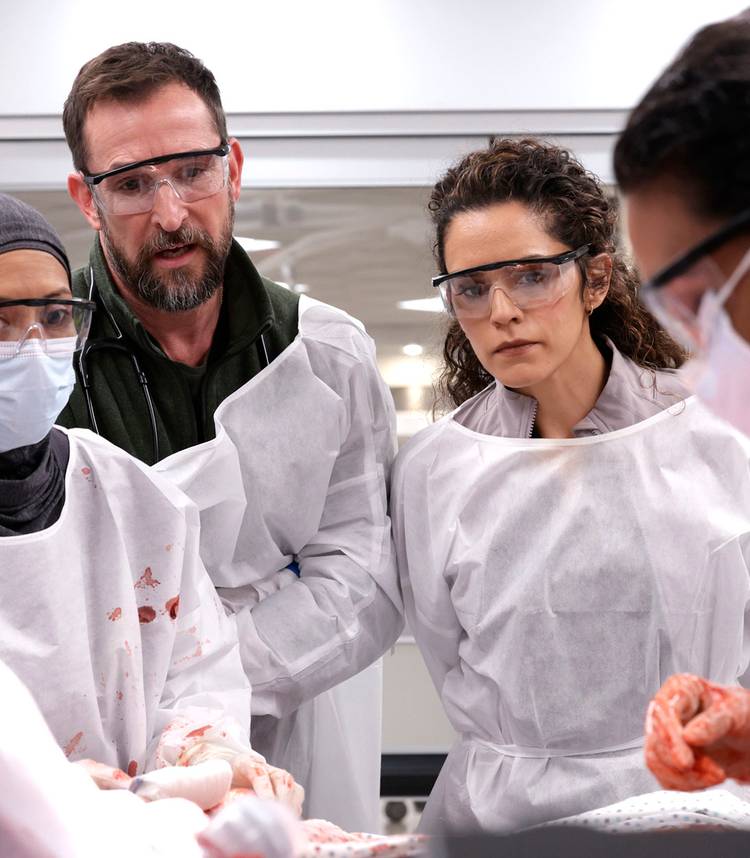
Noah Wyle’s Dr. Robby and Sepideh Moafi’s Dr. Al-Hashimi intently watching a surgical procedure in The Pitt season 2Warrick Web page/HBO Max
Johanna Coelho: Now visually, for the scene itself, it is that stability of, “Okay, we have to see that second, as a result of they’re doing one thing medical that is going to create that stress between them.” So we’d tag that process. We’re very fortunate with this process that we are able to preserve going from it to the precise scene, and it does not should be inserts on a regular basis, which is actually nice. So, we’d go from that, after which, understanding there is a second between two characters who’re exchanging a line about what they’re doing proper now, we are able to catch that on the similar time. It is that stability of what they’re doing medically influencing the evolution of character within the scene.
Coming into The Pitt season 2’s manufacturing, one factor that Coelho says has modified within the present’s visible construction is “we obtained higher at actually creating this immersion and being extra invisible,” together with the way in which they shoot the reasonable prosthetics. Acknowledging that the digital camera is “shifting nonstop” at any given second within the present, she says her and her group “labored tougher” to be “coordinated totally with the actors so we do not exist behind them,” however moderately proper alongside them on the “busy” 4th of July weekend setting:
Johanna Coelho: Yeah, plenty of new tales coming in, which is thrilling. It is clearly very busy on the 4th of July. We have now new prosthetic work in instances. However we wish to really feel just like the viewers does not discover us, which I feel they do not. We have now some new folks coming in as medical doctors, as effectively, and all the time lots of stress, I’d say. However that by no means goes in addition to they wished to. I am actually impressed. And we really feel it on set too, as a result of it is all steady. So the way in which we expertise the story is within the shift with them, and we simply preserve going, as effectively. So it is a stupendous journey to be on.
Coelho Ready A lot Of The Pitt Season 2’s Cinematography With Little Prep
ScreenRant: What has it been like seeing the reception to this present thus far? As a result of clearly, medical dramas are a highly regarded factor, however I really feel like The Pitt has exploded in a approach that not many others on this style have of late.
Johanna Coelho: Yeah, on season 1, once we had been making it, we actually had no thought the way it was going to be obtained. Definitely, we did not think about it was going to be that effectively obtained by a a lot bigger viewers. We thought perhaps folks from ER would return, and a few severe medical drama searchers. However we had been actually making it because it’s one thing in our personal little bubble. I feel perhaps the immersion is what hit the world so effectively. So we had been actually excited, and it appears to be hitting once more on season 2, in order that’s actually good.
ScreenRant: So, turning again to capturing the prosthetics, in season 1, you handled every part from gunshot wounds to degloved legs, all these horrific issues. Was there anybody seeing that proved significantly difficult in both season, whether or not it was due to the prosthetics that you simply talked about or simply due to using as large of the scene as attainable?
Johanna Coelho: Season 1 — it is humorous, we have seen so a lot of them now, I am mixing them. [Chuckles] Humorous sufficient, in season one, you talked about the GSWs. There have been so a lot of them and relying on the place they had been positioned, it was laborious to maintain going and ensure we featured them as we went. If you end up in the primary space, and you retain passing folks which might be harm, I feel the problem was understanding that they had been uncovered sufficient, we might see them and preserve shifting with the characters. That was form of an fascinating problem, as a result of they are not all the time tremendous seen, relying on the place they had been positioned. Larger ones, I bear in mind we had one which was an open coronary heart surgical procedure, and you possibly can see the center beating, and all that. What is tough on the whole is that you’ve got all of the fingers of the medical doctors getting in there, so you’ve got lots of people round [the heart], and it’s important to match two cameras. So, we had been preventing for house a bit bit, as we wished to ensure we captured it. [Laughs] And in a approach, it is actually working with the actors that if on one facet of the digital camera is in a particular spot that they arm it out, so we are able to nonetheless see the fingers in there, however we’ve a bit gap for the digital camera to get in, or that we’re able that we do not see the opposite particular person fingers. Then, we are able to simply clear them, however another person fingers the device or something like that. So, it truly is communication and coordination with the actors, so we are able to make sure you get in there. I feel that is when it will get difficult, too, is to ensure we’ve house, however they’ll nonetheless do their process on the similar time. On season 2, we’ve one other very large open surgical procedure, which is the clamshell, the place they reduce the warfare factor within the center to open the complete factor. I feel it is getting all of the beats right here, and ensuring they’re captured on display. However on the similar time, you additionally see the characters interacting with it. There was a bit little bit of particular results concerned on set with that, as effectively, so it was coordinating all these parts and ensuring we had been on the proper place on the proper time visually. So, I’d say that is the problem on the whole with prosthetic work like that is that each one the items work on the similar time that we are able to see once more with everybody across the desk for it, however we are able to additionally preserve telling the story on the similar time. The resets, generally, are difficult too. We do shoot rather a lot per day, and so generally submit reset takes a very long time. We’re additionally attempting to all the time focus on, “Do we want a reset right here? Ought to we simply do a go above, otherwise you simply see a bit bit, so you do not have to do a full reset on the prosthetic?”
ScreenRant: I learn that generally, particularly in season 2, you had been planning all of this taking pictures out on the day, as a result of you aren’t getting the scripts too far prematurely. I really feel like, in a approach, it is excellent for this present to go in and should run and gun with filming, however provided that there are such a lot of intricate layers to the taking pictures between, once more, discovering that stability between the prosthetics and the medical doctors, and even simply capturing the medical doctors in the primary space, what’s that like for you discovering what the rhythm goes to be on any given day if you end up planning that out on the day?
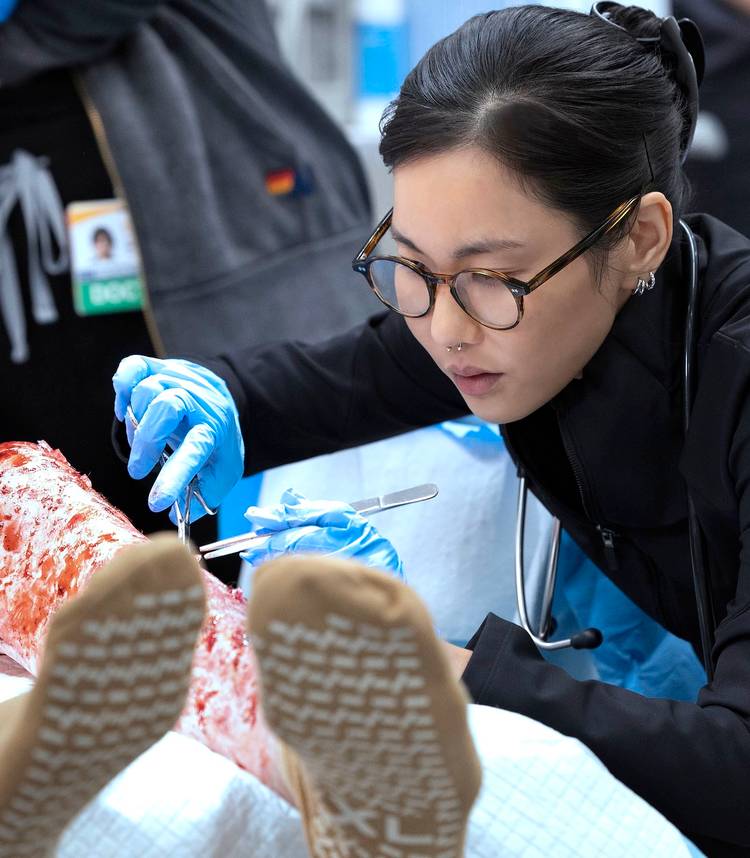
Irene Choi’s Kwon fastidiously eradicating glass from a bloody leg in The Pitt season 2Warrick Web page/HBO Max
Johanna Coelho: So, the administrators get the prep — as a result of we’ve totally different administrators coming in — they’ve talked in regards to the prosthetic work, they’ve most likely made a plan about how they wish to method every part. However on my facet, it is true on the day. I do know the scenes, I get the script a couple of week earlier than, and I learn them, however there’s lots of improvisation on my facet. The planning occurs on the second principally. So, the pictures are designed really from the blocking. So, within the prepping stage, the director will do the blocking, we focus on it after which there is a large query that we ask, “Okay, whose scene is that this? Who’s main that scene?” As a result of the present is all about immersion and perspective. So this scene is about Dr. Robby, and it is actually vital that you simply perceive his battle with Dr. Langdon. So, we speak about, “Take the medical out, what’s the scene about?” We all know who we comply with, who we see the scene from, and the way we seize the second we want. That is actually how the shot will get made on the spot. So, we’d begin with that one primary shot that retains going from the start to the top of the scene, usually following our primary character or main them. It relies upon what we desire to begin with, and actually getting all of the scene that approach. Then, we do the other approach, so you may make positive to intercut them collectively, however we’re actually taking pictures it as from the start to the top of the scene, that is how we design our pictures. “We actually want extra element on this prosthetic. We could not entry that in our lengthy shot, so let’s get this bit right here. We have to actually perceive what is going on on the screens at this second proper over our shoulders. Let’s do this now.” So then, it is actually a extra cleanup or tighter shot. “We have to get extra within the face for the emotion at this second,” or something like that. However we frequently design our pictures from, “Let’s get the scene nearly as a oner, after which we’ll do the other approach, after which we do a cleanup.”
ScreenRant: I do love the lengthy takes that you’ve got as a result of it actually does, such as you say, work nice for the immersion of this collection, and of those characters as they are going from one room to the following and speaking about three totally different sufferers without delay.
Johanna Coelho: We tried to design the pictures in the way in which that we wish to make it possible within the edit to not all the time reduce. So, once we design the shot, and we speak about them, it is like in case you preserve going with the digital camera, otherwise you come round, then you’ll be able to preserve the scene going with out having to have a reduce in there, so it provides that feeling of continuity and by no means stopping within the shift.
Supriya Ganesh’s Dr. Samira Mohan performing chest compressions whereas Noah Wyle’s Dr. Robby supplies oxygen to a affected person in The Pitt season 2Warrick Web page/HBO Max
ScreenRant: One factor I used to be interested by as effectively is that I do know that the hospital is throughout a number of sound levels, and I am curious how a lot involvement you’ve got with the manufacturing design of discovering the right layouts with a purpose to craft these lengthy takes.
Johanna Coelho: So, on season 1, after I obtained concerned within the present, the set was already designed by the manufacturing designer, Nina Ruscio, earlier than they even began writing on the present. Step one was the design of the hospital, they usually wanted that design to write down the present, as a result of it is steady. They wanted to know the place they will put the affected person, the place they’re going to transfer from, which room to which, et cetera. So, the set design was the very first thing. Now, after I obtained concerned, it was the stage earlier than the lighting was built-in, earlier than the colour of the partitions had been chosen. I knew it was going to be white, however what sort of white, what sort of shine — all of those parts — what colour are the counters, are we placing lights above the beds? So, I got here in round that stage the place filling within the design was actually vital for that immersive side of it. We actually labored hand-in-hand with Nina to create a set that’s totally immersive and that, lighting smart, there’s nothing on the bottom. It is a full-life theater for actors to maneuver round. So, it is designed in a approach that we speak about placement of sunshine, what sort of lights we management, each single mild we’ve our personal in strips in them, but in addition the place that visually is smart. So, it is a collaboration of design and lighting, the kind of white partitions we obtained. We did so many checks, a lot testing with the manufacturing designer, as a result of we knew we had a variety of pores and skin tones within the forged, so we wished to ensure we picked white in order that while you see everybody, it displays, and it really works on each pores and skin tone. It displays them in a extremely reasonable approach, and that there is not one pores and skin tone that appears higher than the others, due to the kind of white. After which, we’ve some onboard lights on the digital camera that basically assist to create the sensation of shifting. After which we even have a light-weight on the pole, so something we add is shifting with the digital camera. There’s nothing that is set or blocking the way in which in any approach.
New episodes of The Pitt season 2 stream on HBO Max Thursdays at 9 p.m. EST!