

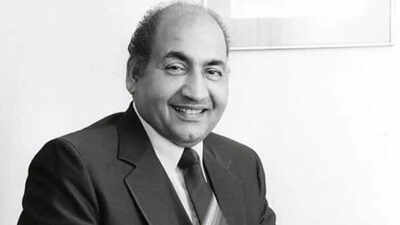
Born in 1924 in a small village close to Amritsar, Mohammed Rafi’s first spark of inspiration got here from a travelling fakir whose songs he would quietly comply with by means of the streets. Although he later educated underneath a maestro, his ardour for music was met with resistance at dwelling. Rafi’s conservative father disapproved of singing as a career, and the younger boy grew up torn between his love for music and his household’s strict values. Even after changing into considered one of India’s most celebrated playback singers, Rafi typically questioned if his work was sinful. Decided to maintain his youngsters away from the trade, he despatched them to London to pursue completely different paths. His son, Shahid Rafi, has typically spoken about his father’s childhood in Lahore and about his marriage to—and eventual separation from—his cousin, Bashira.
A narrative destined for the cinema
In a YouTube interview with Vickey Lalwani, Shahid revealed that he’s engaged on a biopic about his father with director Umesh Shukla. The movie, he stated, will hint Mohammed Rafi’s journey from childhood to his last days. “I wish to present how he began singing from the age of eight or 9, how he was impressed by a fakir who would stroll by means of their neighborhood in Lahore, enjoying a easy string instrument. My father would comply with him round silently, taking in his voice… The fakir requested him to sing and was impressed by his expertise. He blessed my father and stated that he would go far.” Rafi himself recalled an identical reminiscence in a 1977 BBC Hindi interview:“I used to stay in a small village close to Amritsar, and a fakir used to go to typically. He would sing for cash. I used to like his voice, and I’d comply with him round for lengthy distances. I developed a love for singing after listening to that fakir.”
A household divided over music
Shahid remembered how the family remained break up over younger Rafi’s goals. “My grandfather was useless towards the concept of him singing. He would say, ‘Marasiyon ka kaam nahi hai humara. Yeh galat kaam hai, yeh sab hum nahi karte (We’re not singers; that is improper).’ Our grandmother was very encouraging of him, although. She stated, ‘Tu fikar mat kar, fundamental sambhal lungi (Don’t fear, I’ll deal with it).’… He cooled down after he heard my father’s voice in a Punjabi movie, after which he himself stated, ‘Sangeet ki jeet hui hai (Ultimately, music received).’”
Childhood in Lahore and the partition’s ache
When the household moved to Lahore, Rafi’s father arrange a barbershop the place the younger boy typically helped, trimming beards and slicing hair. However destiny had larger plans. Noticed by somebody from a Lahore radio station, he was inspired to attempt his luck in Bombay. By then, he had sung in just a few pre-Partition Punjabi movies and in 1945 recorded his first Hindi movie music. Partition, nonetheless, shook his private life. Whereas Rafi stayed in India to pursue his profession, his spouse, Bashira, refused to go away Lahore. Shahid recalled, “She was associated to Dad. She was his cousin. She didn’t wish to come to India. Dad requested her to return and stick with him, however she refused. Dad stated, “Okay then, give me my son.” Rafi introduced his eldest son with him, and Shahid later revealed he didn’t even know till a lot later that his elder brother wasn’t his organic mom’s baby. “My mother and father by no means handled him any otherwise. In truth, my mom appeared to like him extra. He was all the time considered one of us, seven brothers,” he stated.
Bombay goals and a reluctant father’s consent
In his last interview with Star & Model, given simply weeks earlier than his passing, Rafi mirrored on his early struggles. “I’m a local of Lahore. I belong to a really orthodox and conservative Muslim household. I used to sing at buddies’ locations once I was solely 15. Throughout one such event, Nasir Khan, one of many prime producer-actors at the moment, noticed me and provided to take me to Bombay and groom me as a singer in movies… My father had refused the provide point-blank… When Nasir Khan persevered with the provide, my elder brother satisfied my Abaajaan to let me go to Bombay. With nice reluctance, my dad agreed to my pursuing a profession as a singer in movies.”
Recollections of Saigal Saab and Rs 75 a music
Reflecting on these years, Rafi recalled, “Filmmaking wasn’t merely a enterprise proposition throughout these days when establishments reigned supreme and freelancing hadn’t develop into common… Consider it or not, I was paid a meager quantity of Rs 75 in these days for one music!” He additionally remembered with heat the encouragement of senior singers. “Once I entered the road, there have been, in fact, common singers like Saigal saab (KL Saigal), GM Durrani, and Khan Mastan… As a substitute of contemplating me one other competitor, they inspired me to present my finest. In truth, I keep in mind the primary time I met Saigal Saab at Lahore… The mike had failed on the final minute. Whereas it was being set proper, I used to be requested to maintain the viewers engaged by singing a few songs. I used to be solely 15 then… Saigal Saab blessed me that day and predicted {that a} day would come once I could be a sought-after singer.”
A voice that lives perpetually
Mohammed Rafi handed away in 1980 on the age of 55. Many years later, his voice continues to echo throughout generations, not simply as music however as a reminiscence of perseverance, humility, and divine expertise.